
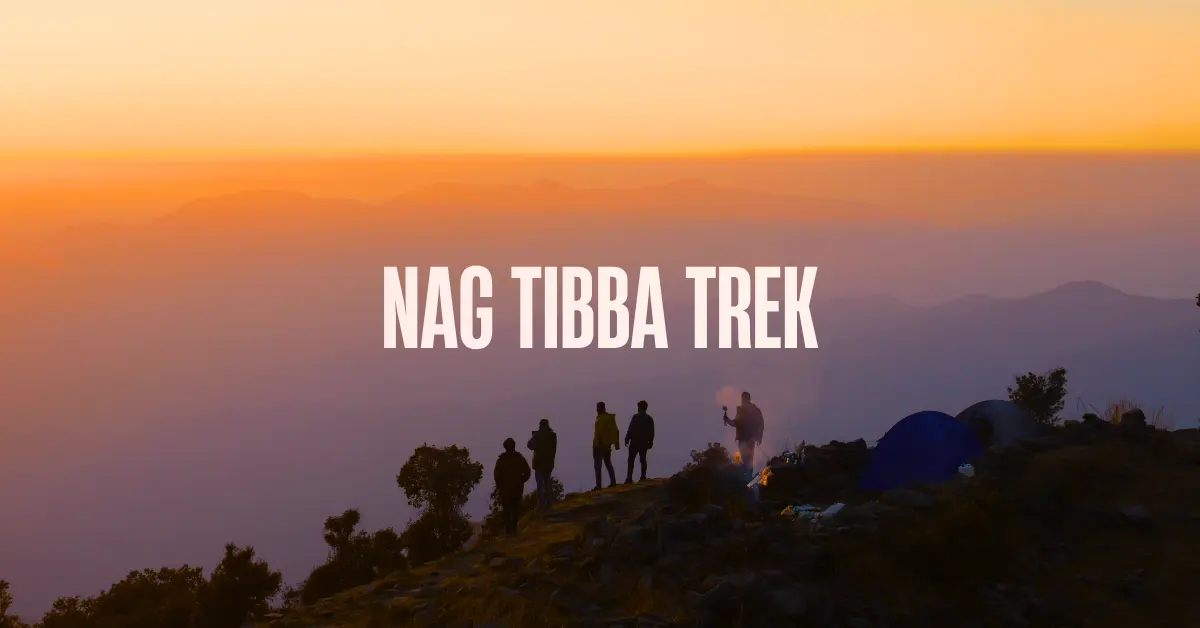
You do not always need a week off to experience the Himalayas.
Sometimes, two days are enough. That is exactly what the Nag Tibba trek gives you.
A summit climb. Dense forests. Ridge walks. A 100-degree view of snow-capped Himalayan peaks. And a campsite under a sky full of stars. All within a weekend.
Nag Tibba sits at 9,915 ft. It is the highest peak in the Nag Tibba range of the Garhwal Himalayas. From the top, you see Swargarohini, Bandarpoonch, Kala Nag, Srikanth, Gangotri, Kedarnath, and the snow-covered peaks of Changabang stretching across the horizon. The Doon valley spreads out far below.
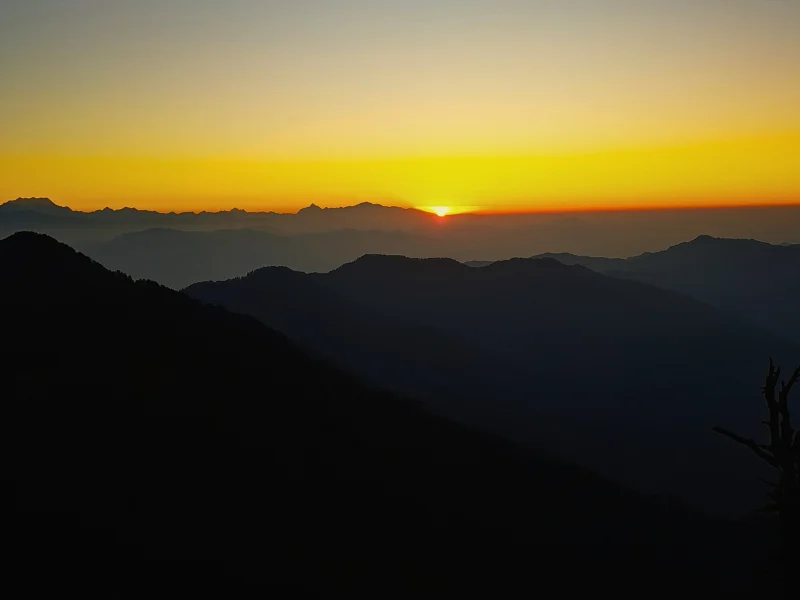
The trail takes you through dense forests, open clearings, and a final steep push to the summit. You go up one side of the mountain and come down the other. Every hour of trekking brings a completely different landscape.
This trek is only about 100 km from Dehradun. It is ideal for people in Delhi, Dehradun, and the NCR who want a proper mountain experience over a weekend. And for first-time trekkers, this is one of the best places to start.
What Makes Nag Tibba Special
1. A Real Summit Climb in Just Two Days
Most summit treks take 5 to 7 days. Nag Tibba gives you the same thrill – the climb, the effort, the final push, the view from the top – in just two days.
The summit at 9,915 ft is not handed to you easily. The last 1 km is a steep, forested climb with four sharp ascents. The trees block the sunlight. In winter, the snow does not melt here. You earn the top.
And when you get there, the views make every difficult step worthwhile.
2. Himalayan Views That Span 100 Degrees
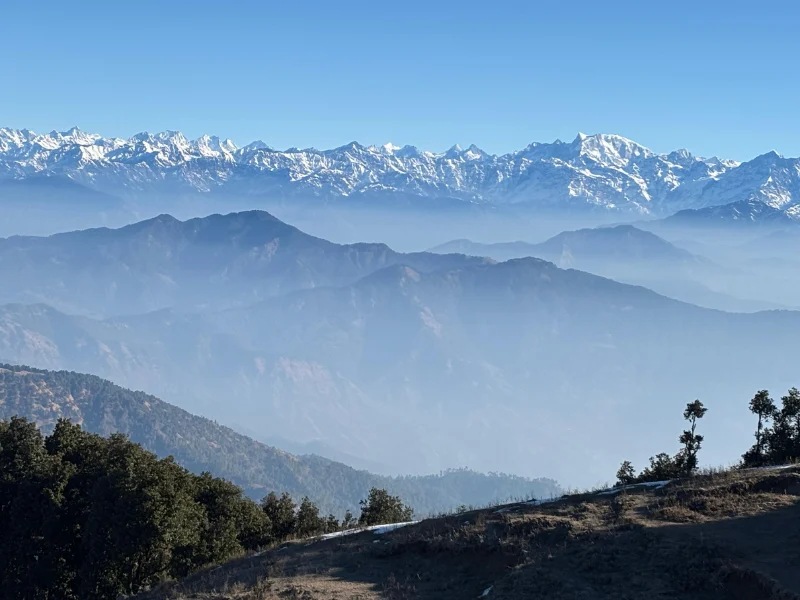
From Nag Tibba summit, the Himalayan panorama opens up in a wide sweep. Bandarpoonch and Swargarohini to the west. Gangotri range ahead. Kala Nag and Srikanth. Kedarnath peak in the north. The Doon valley spreading out below.
On a clear winter morning, the entire landscape is covered in snow. It looks like the world was rebuilt overnight just for you.
3. Beautiful Forest Trails
The trail passes through some of the most beautiful forests near Mussoorie. Oak trees, rhododendrons, pine, and conifer forests line the path on both days.
In spring, rhododendrons bloom on the trees as you climb. In autumn, the leaves turn brown and orange and the whole trail glows with warm colour. In winter, snow settles softly on the branches and the morning light cuts through at magical angles.
The forest is different in every season. And beautiful in all of them.
4. Perfect for Weekends and Beginners
The total trek distance is about 11.8 km over two days. No prior trekking experience required. The trail is well-defined for most of the way. The campsites are comfortable. And the drive from Dehradun is under 5 hours.
If you are introducing a child, a parent, or a friend to trekking for the first time – Nag Tibba is the right choice. It gives them the full experience without overwhelming them.
5. The Nag Tibba Temple
Halfway up the summit trail, you reach the Nag Tibba Base. Here stands a temple dedicated to Naag Devta – the Serpent God. The temple is painted in bright colours and sits quietly in the middle of the forest. It is a peaceful and beautiful spot.
Local communities have deep reverence for this temple. Take a moment here before the final climb.
Quick Itinerary
| Day | Route | Distance | Duration | Altitude |
|---|---|---|---|---|
| Day 1 | Drive Dehradun to Panthwari + Drive to Goat Village + Trek to Khatian | 2.5 km trek | 2-3 hrs | 4,652 ft to 7,506 ft |
| Day 2 | Trek Khatian to Nag Tibba Summit + Descend to Goat Village + Drive to Dehradun | 9.3 km | 5-6 hrs | 7,506 ft to 9,915 ft and back to 4,652 ft |
Day by Day Trail Guide
Day 1: Drive from Dehradun to Panthwari. Drive to Goat Village. Trek to Khatian.
Drive Distance: 100 km (Dehradun to Panthwari) + 10 km (Panthwari to Goat Village)
Drive Duration: 4-5 hours + 1 hour
Trek Distance: 2.5 km
Duration: 2-3 hours
Altitude Gain: 4,652 ft to 7,506 ft
Difficulty: Moderate
The drive itself is one of the highlights of this trek. You leave Dehradun and drive through Mussoorie – the queen of hills – and then over the Yamuna Bridge at Kempty Falls. The road winds through Nainbagh and then up to Panthwari village. Mountains appear on all sides. The Doon valley drops away behind you.
From Panthwari, the trek route to Nag Tibba begins.
A Quick Note on Reaching Nag Tibba Base
This is something most articles and guides have not mentioned yet. As a locally based team, we have recent ground-level information.
There is now a motorable road from Panthwari that goes all the way to Nag Tibba Base Camp – a distance of about 15 km by road. Previously, the only option was to trek up from Panthwari or Goat Village. This new road changes things.
The road is not fully developed yet. Small vehicles may struggle at a few rough patches. But for the most part, it is driveable. If you have a suitable vehicle – preferably a 4×4 or a high-clearance SUV – you can drive directly to the base and skip the lower forest section entirely.
If you want the full trekking experience, stick to the traditional route via Goat Village. But if you are short on time, or if you have older or less mobile members in your group, the new road is a genuine option worth considering.
We will update this information as the road conditions improve.
The Traditional Trekking Route
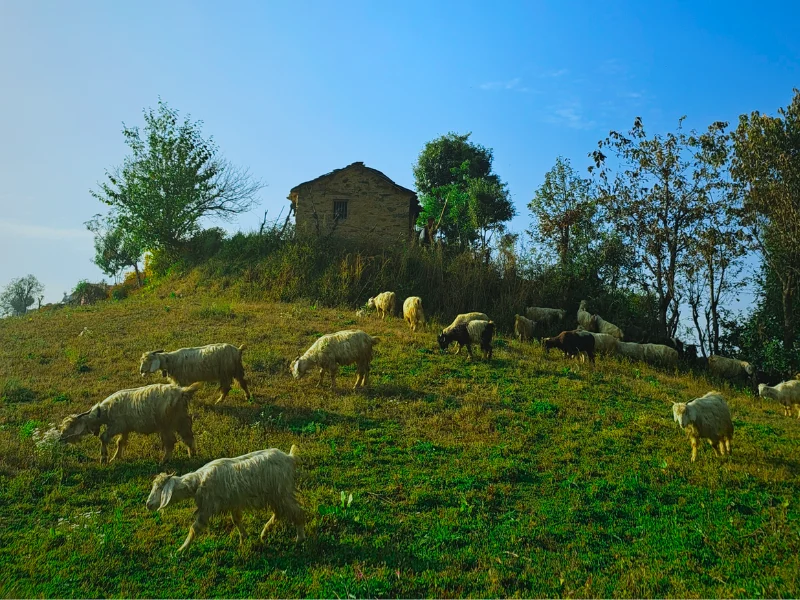
From Panthwari, take the 10 km offroad drive to Goat Village. The road is bumpy and fun.
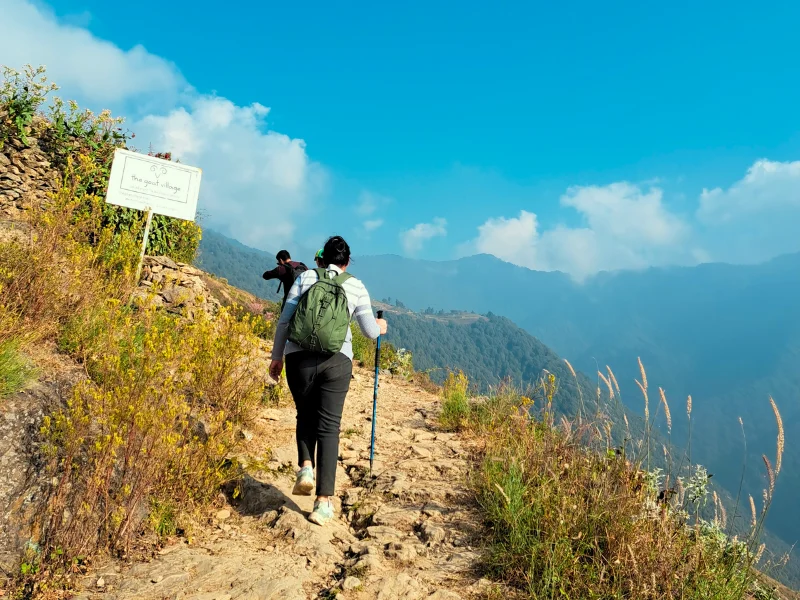
The trek from Goat Village to Khatian is 2.5 km. The trail starts on a stone path laid by the Forest Department. It is a gradual ascent with long patches of loose stones. The forest begins almost immediately. Oak trees and rhododendrons crowd the trail.
This is the section where the trek builds up. About 20 minutes in, you hit the forest check post. From here, the trail gets more defined and the forest thicker.
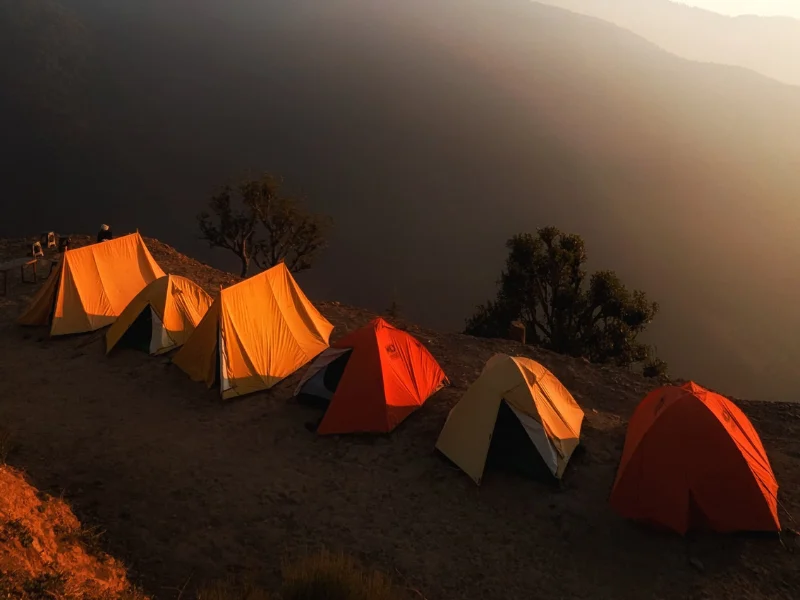
About 2 to 2.5 hours of walking brings you to Khatian – a small clearing surrounded by forest. This is your campsite for the night.
The evenings here are quiet. Watch the sun set behind the mountains and turn the sky orange and pink. At night, the stars come out with no city lights to compete.
Sleep well. Tomorrow is a big day.
Day 2: Trek from Khatian to Nag Tibba Summit. Descend to Goat Village. Drive to Dehradun.
Trek Distance: 9.3 km
Duration: 5-6 hours
Altitude Gain and Loss: 7,506 ft to 9,915 ft to 4,652 ft
Difficulty: Moderate
Start early. Today is a long day with a lot of walking. An early start also means you reach the summit before the afternoon clouds roll in.
From Khatian, find the trail going right, straight into the forest. Most of the route to the summit stays inside a dense forest cover. The trails are well-defined. But pay attention – there will be at least one junction where three trails branch out. Only one leads to the summit. Do not rely only on your instincts here. A local guide is strongly recommended.
Note: In January and February, snow covers the trail and makes it hard to follow. If you are trekking in winter, a guide who knows this route is not optional – it is essential.
The two landmarks to watch for on the 2 km trail to Nag Tibba Base are two small open clearings in the forest. You pass the first one about 20 minutes from Khatian, and the second about 35 minutes in. Use them to gauge your progress.
Nag Tibba Base is a large clearing. The Naag Devta temple stands here, painted in bright colours, quiet and peaceful in the middle of the trees. Stop here. Rest. Have some water and a snack.
From the temple, the real climb begins.
The last 1 km to the summit is steep. The forest is dense and the trees block out most of the sunlight. In winter, the snow here does not melt. Four sharp ascents test your fitness and your determination. It takes 1 to 1.25 hours to cover this last stretch.
Do not stop. Keep moving. One step at a time.
And then the trees part. The trail curves towards a ridge on the left. You walk for a minute more – and you are at the top.
Look for the flag pole. That is the Nag Tibba Jhandi. The highest point.
Stand here and turn to the left-hand slope. The panorama opens up completely. Bandarpoonch, Swargarohini, Kala Nag, Srikanth, Gangotri range. Kedarnath in the north. The Doon valley far below. In winter, every peak wears a thick coat of snow. The entire scene looks unreal.
Take your time here. You earned this.
The Descent
Retrace the route back to Nag Tibba Base, then down to Goat Village. The descent is steep in places. Use your trekking poles. Take care on the loose stone sections – your legs will be tired by this point.
From Goat Village, drive back to Panthwari. From there, the road takes you back through Mussoorie and down to Dehradun.
You reach Dehradun by around 10 pm.
How Difficult Is the Nag Tibba Trek?
This is a moderate trek. It is suitable for fit beginners.
Total trekking distance is about 11.8 km over two days. The altitude gain is rapid – from 4,652 ft to 9,915 ft over just two days. This is one of the steepest altitude gains in such a short time.
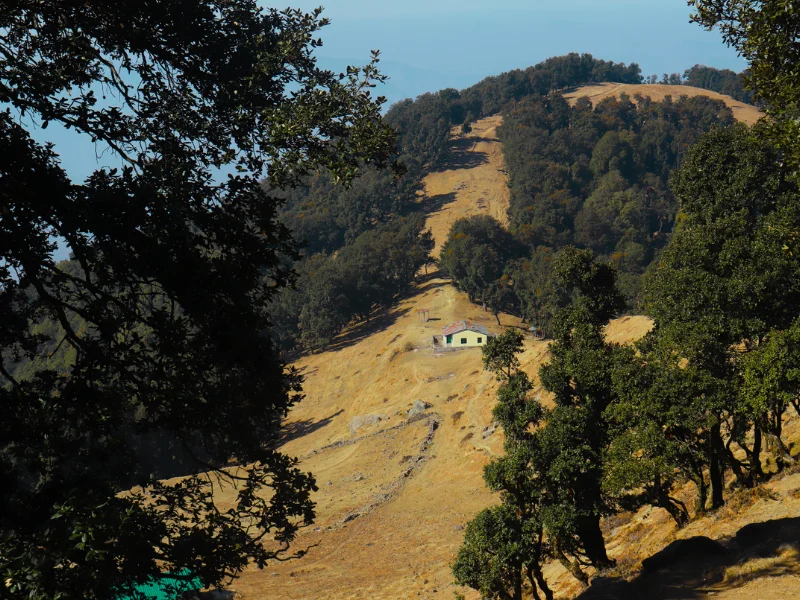
The most challenging section is the final 1 km to the summit on Day 2. It is steep, forested, and has four sharp ascents. If you are not fit, this section will be very hard.
Train before you come. The trek is short – but it is not easy.
Is the Nag Tibba Trek Safe?
Yes – if you are informed and prepared.
Terrain Safety
The trails at Nag Tibba are mostly well-defined. But there are junctions where the trail splits and one wrong turn can take you to a village instead of the summit. Always trek with a local guide who knows the route well.
The last 1 km to the summit is steep and rocky. In winter, snow makes it slippery. Take your time. Do not rush this section.
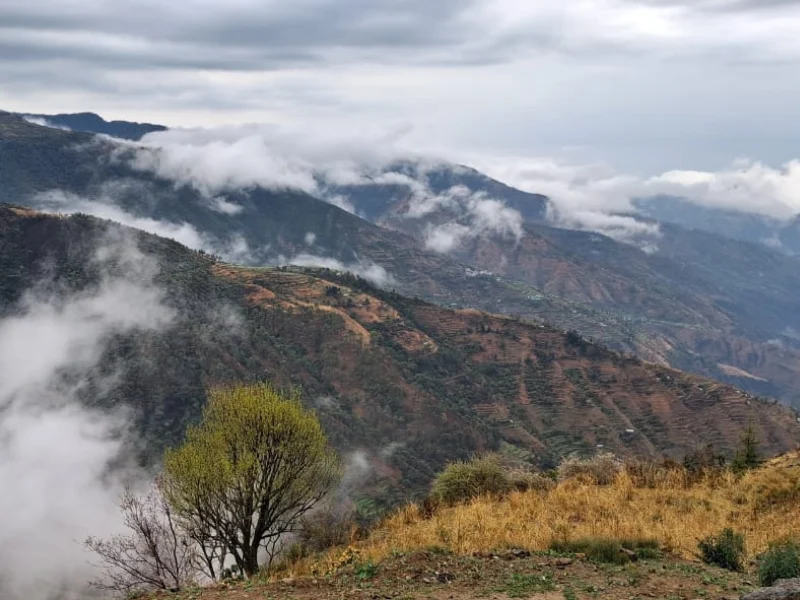
On the descent, the loose stone sections on the forest trail require careful footing. Use trekking poles.
Altitude Safety
Do not underestimate this. You gain over 5,000 ft in altitude in just two days. That is a rapid ascent by any standard.
Acute Mountain Sickness (AMS) is a real possibility even at 9,915 ft, especially if you climb too fast. AMS does not care about your fitness level. It can hit anyone.
Watch for these symptoms:
- Persistent headache
- Dizziness
- Nausea
- Loss of appetite
- Weakness
- Poor sleep
If you notice any of these, descend immediately.
Stay hydrated. Drink at least 2 to 3 litres of water on trekking days.
Weather Safety
The weather in the Nag Tibba range can change quickly. A clear morning can turn cloudy and rainy by afternoon.
Rain makes the loose stone trail slippery and risky. Snowfall in winter can cover and obscure the trail entirely. If it has been raining heavily or snowing for several hours, be prepared to turn back or wait.
Always start the summit push early in the morning to avoid afternoon weather changes.
Emergency Exits
If you have not gone too far into the trek, descend back to Panthwari. From Panthwari, the nearest medical help is a short drive away.
If you are deep into the trek after Day 2, the best option is to descend towards Bhatwadi village.
The closest medical facility is at Panthwari or Bhatwadi. For more serious emergencies, Dehradun and Mussoorie are about 3 hours away by road. They have better hospital facilities.
Best Time to Do the Nag Tibba Trek
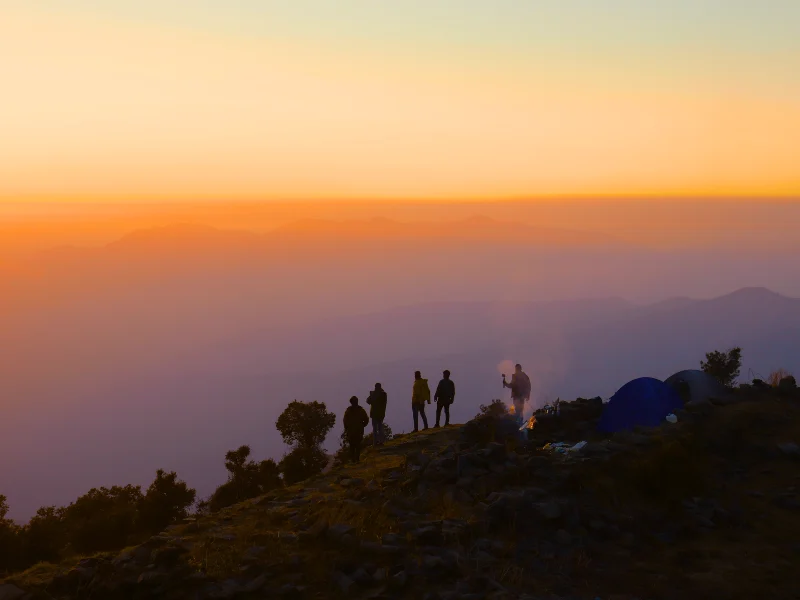
Nag Tibba is one of the few treks that is genuinely good in all four seasons. Each one offers a completely different experience.
Autumn (September to November)
This is the best time for clear skies and crisp mountain views. After the monsoon washes the haze away, the visibility is excellent. The mountains look sharp and stunning.
The forests turn brown and orange. The trail is at its most colourful and photogenic.
Highly recommended.
Winter (December to February)
The most magical version of this trek. Snow covers the trail, the trees, and the campsite. The forests look like something out of a fairy tale.
The morning light hitting the snow on the west-facing slopes is incredibly beautiful. The summit views in winter – with every peak snow-covered – are the best you will see on this trek.
You will need proper winter gear and a guide who knows the snow-covered trail.
Spring (Mid-March to April)
The snow begins to melt at the upper reaches. Fresh green grass appears. Rhododendrons bloom in bright red and pink all along the trail.
The forest wakes up. Birds return. Spring brings warmth, colour, and clear skies.
A wonderful time to come.
Summer (May to June)
The trail turns fully green. Coniferous and oak forests look bright and full. The weather is pleasant and the trek is at its easiest.
Ideal for families with children. A great escape from the heat of the plains.
Clear mornings give good mountain views before the afternoon clouds build.
Temperature Guide
| Season | Panthwari / Goat Village | Khatian Camp | Nag Tibba Summit | Night Temperature |
|---|---|---|---|---|
| Sept-Nov | 15-22°C | 10-16°C | 5-10°C | 2-6°C |
| Dec-Feb | 2-10°C | -2 to 5°C | -8 to -2°C | -10 to -4°C |
| March-April | 12-20°C | 8-14°C | 3-8°C | 0-5°C |
| May-June | 18-26°C | 12-18°C | 7-12°C | 5-10°C |
Carry warm layers even in summer. Nights at the Khatian campsite can be surprisingly cold.
How to Reach Panthwari – Base of the Nag Tibba Trek
Panthwari is about 100 km from Dehradun and takes 4 to 5 hours by road.
The Route
Dehradun → Mussoorie → Kempty Falls → Yamuna Bridge → Nainbagh → Panthwari
From Nainbagh’s main market, turn right onto the Nag Tibba road. After 12 km, you reach Panthwari village.
From Dehradun by Public Transport
Take a shared taxi or bus from Dehradun to Mussoorie. From Mussoorie, take a local taxi or shared vehicle towards Nainbagh. From Nainbagh, hire a local vehicle to Panthwari.
From Delhi
Take an overnight bus or train to Dehradun. Buses from ISBT Kashmiri Gate to Dehradun are frequent. Train options from Hazrat Nizamuddin or New Delhi station are also available.
Tip: Arrive in Dehradun the evening before. Start the drive to Panthwari early the next morning to maximise your trekking time.
A Note on the New Road to Nag Tibba Base Camp
This is something worth knowing before you plan your trip.
Until recently, the only way to reach Nag Tibba Base Camp was by trekking up from Goat Village. But there is now a motorable road from Panthwari that goes all the way to the base camp – covering about 15 km by road.
The road is not yet fully developed. There are rough patches where small vehicles may struggle. A high-clearance vehicle or 4×4 is ideal. But for the most part, the road is driveable.
This opens up the trek in an interesting way. Trekkers who want only the summit experience – without the full two-day itinerary – can now drive to the base and attempt the summit the same day.
It also makes this trail more accessible for families with older members or young children.
We will keep updating this as road conditions change. If you are planning to use this road, check with locals in Panthwari for the latest condition before you set out.
Stay Options
At Panthwari
A few local homestays are available. Simple, clean, and very welcoming. A good option for the night before or after the trek.
At Mussoorie
Plenty of hotels at every budget. If you want more comfort before the trek, stay a night in Mussoorie – it is just 30 km from Panthwari.
At Dehradun
Wide range of options. Zostel in Dehradun is a good budget choice for solo trekkers and groups. Bunk beds from around Rs 400.
Frequently Asked Questions
How long is the Nag Tibba trek?
The total trekking distance is about 11.8 km over two days. The summit is at 9,915 ft.
Where does the trek start?
The trek traditionally starts from Goat Village, reached after a 10 km offroad drive from Panthwari. Panthwari is the base village, 100 km from Dehradun.
Can you drive to Nag Tibba Base Camp now?
Yes – partially. There is a new road from Panthwari to Nag Tibba Base Camp, about 15 km by road. The road is not fully finished. Small vehicles may struggle at some patches.
A high-clearance or 4×4 vehicle is recommended. Check local conditions before using this route.
Is this suitable for complete beginners?
Yes. Nag Tibba is one of the best beginner treks near Dehradun. The trail is short, the gradient is manageable, and the experience is rewarding.
That said, you need basic fitness. Train for 3 to 4 weeks before attempting it.
Is a guide necessary?
Strongly recommended. There are junctions on the trail where three paths branch out and only one leads to the summit. In winter, snow covers trail markers entirely.
A local guide who knows the route makes the trek significantly safer.
Can children do this trek?
Yes. Families regularly do this trek in summer and spring. Children above 8 or 9 years who are reasonably active should manage it well with some support on the steeper sections.
What is the Nag Tibba Temple?
Nag Tibba Base has a temple dedicated to Naag Devta – the Serpent God. Local communities worship here, and pilgrims visit during the Nanda Devi Jat Yatra. It is a beautiful and peaceful spot on the trail.
Nag Tibba is proof that you do not need a week off to feel the Himalayas. Two days. One summit. Views that stretch for a hundred degrees. And a night under a sky full of stars.
Pack your bag on Friday. Be on top of a mountain by Saturday. Back home by Sunday night.
That is the beauty of Nag Tibba.